

How To Draw A Farm Detailed With Everything You Have On A Farm In The Middle Colonies
 | |
| Regional statistics | |
|---|---|
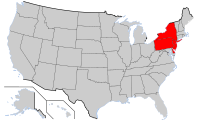
| U.Southward. States | Delaware New Jersey New York Pennsylvania |
The Middle Colonies were a subset of the Thirteen Colonies in British America, located between the New England Colonies and the Southern Colonies. Along with the Chesapeake Colonies, this surface area now roughly makes upwardly the Mid-Atlantic states.
Much of the expanse was part of New Netherland until the British exerted their command over the region. The British captured much of the area in their war with the Dutch around 1664, and the bulk of the conquered land became the Province of New York. The Duke of York and the Rex of England would subsequently grant others ownership of the land which would become the Province of New Jersey and the Province of Pennsylvania. The Delaware Colony subsequently separated from Pennsylvania, which was founded past William Penn.
The Middle Colonies had much fertile soil, which allowed the expanse to become a major exporter of wheat and other grains. The lumber and shipbuilding industries were also successful in the Middle Colonies because of the abundant forests, and Pennsylvania was moderately successful in the textile and fe industries. The Center Colonies were the near ethnically and religiously diverse British colonies in North America with settlers from England, Scotland, Ireland, holland, and German states. Farm land was both productive and much less expensive than in Europe. Afterward settlers included members of diverse Protestant denominations, which were protected in the Middle Colonies past written freedom of religion laws. This tolerance was very unusual and singled-out from the situation in other British colonies.
History
The Centre Colonies were explored by Henry Hudson for the Dutch Eastward Republic of india Visitor in 1609, sailing upwardly the Hudson River to present-twenty-four hour period Albany, New York, and forth the Delaware Bay. The Dutch further explored and charted the area in multiple voyages between 1610 and 1616; the starting time Dutch settlements were built in 1613 and the name New Netherland appeared on maps from 1614 on. With Swedish funding, the third governor of New Netherland later founded the colony of New Sweden in the region around Delaware Bay in 1638. This area was reclaimed by the Dutch in 1655.[1] In Oct 1664, every bit a prelude to the Second Anglo-Dutch War, the English largely conquered this country from the Dutch. Though the war concluded in a Dutch victory in 1667, the English retained New Netherland and renamed it New York after the English King's blood brother, the Knuckles of York, who had co-instigated the war for personal gain and had commanded the attack on New Netherland.[2] [iii] [four] In 1673, the Dutch retook the area but relinquished it under the Treaty of Westminster (1674), catastrophe the Third Anglo-Dutch State of war the next year.
Province of New Jersey

Map showing the borders of W New Jersey (left) and East New Jersey (right)
King Charles Two renamed the land west of the Hudson River New Jersey and gave the region between New England and Maryland to his blood brother, the Duke of York (later Male monarch James II of England) as a proprietary colony.[two] James II later granted the land between the Hudson River and the Delaware River to 2 friends who had been loyal to him through the English Ceremonious War: Sir George Carteret and Lord Berkeley of Stratton. This state grant became the Province of New Bailiwick of jersey.[5] [6]
In 1665, the Concession and Agreement was written in an effort to entice settlers to New Jersey. This document provided for religious freedom, no taxes without assembly approval, and a governor appointed past the proprietors.[7] The first governor appointed in this way was Philip Carteret, who founded Elizabethtown. Colonists were required to pay annual quit-rent taxes. On March xviii, 1674, later on encountering difficulty collecting the taxes, Lord Berkeley sold his share in the colony to Edward Byllynge, a Quaker businessman from London.[8] This sale divided New Bailiwick of jersey into E Jersey and Westward Jersey; however, the border between the ii was not agreed upon until the Quintipartite Human activity in 1676. From 1701 to 1765, colonists skirmished in the New York-New Jersey Line War over disputed colonial boundaries.
On April 15, 1702, Queen Anne united Westward and E Jersey into ane Royal Colony, the Province of New Jersey.[9] Edward Hyde, tertiary Earl of Clarendon became the majestic colony's first governor. Afterward Hyde was recalled to England in 1708 over charges of graft, bribery, and corruption, the governor of New York was charged to also preside over New Jersey.[9] Finally, in 1738, Rex George Two appointed a separate governor, Lewis Morris, to run New Jersey.[5]
The Provincial Congress of New Jersey, made up of elected delegates, formed in January 1776 to govern the colony. The Congress had Royal Governor William Franklin arrested on June 15, declaring him "an enemy to the liberties of this country".[x] On July ii, 1776, New Bailiwick of jersey enacted the New Jersey Country Constitution, presently after having empowered delegates to the Continental Congress, on June 21, to join in a announcement of independence. The Usa Declaration of Independence ended their colonial status.[6]
Province of Pennsylvania

Rex Charles II granted the land for the Pennsylvania Colony to William Penn on March 4, 1681 as payment for a debt the crown owed his family.[11] Penn wrote the Frame of Government of Pennsylvania before parting for the colony, which called for religious tolerance towards many groups, including the Religious Lodge of Friends and local natives.[12] As a proprietary colony, Penn governed Pennsylvania, yet its citizens were still subject to the English crown and laws.[12] [13] Penn'due south cousin William Markham served equally the get-go colonial deputy governor.[11] [13]
Demarcated by the 42nd parallel n and 39th parallel north, Pennsylvania was bordered past the Delaware River and the colonies of New York, Maryland, and New Bailiwick of jersey.[13] In 1704, Dutch state given to Penn by the Duke of York was separated and once more became office of the Delaware Colony.[12] From 1692 to 1694, revolution in England deprived Penn of the governance of his colony. The Pennsylvania Assembly took this opportunity to request expanded power for elected officials, led by David Lloyd. Upon visiting the colony in 1669 and 1701, Penn eventually agreed to let their Charter of Privileges to exist added to the constitution.[thirteen] When the British banned western expansion in 1764, fighting among colonists and against the natives swelled. In 1773, Arthur St. Clair ordered the arrest of a Virginian officer who was commanding troops against armed settlers loyal to Pennsylvania. Pennsylvanian revolutionary sentiment continued to abound, and Philadelphia, the largest city in America, before long became the meeting place of the Continental Congress. The publication of the Pennsylvania Constitution of 1776 past locally elected revolutionaries concluded the history of the Colony, and began the Commonwealth of Pennsylvania.
Province of New York
The first Dutch settlements in the New York expanse appeared around 1613. The English captured the New Netherland Colony from the Dutch in 1664, renaming it the Province of New York after the King'southward brother, the Duke of York (afterward King James 2).[3] The Dutch recaptured the colony in July 1673 during the 3rd Anglo-Dutch War, but gave it dorsum to the English language nether the Treaty of Westminster in exchange for Suriname. The Duke of York never governed the colony himself: he instead appointed governors, councils, and other officers to run the government. Richard Nicolls served every bit the first governor of New York.
In 1665, the Province of New Jersey split from New York; however, the New York-New Jersey Line War connected until the final borders were decided in 1769, and approved by the legislatures and the Rex in 1772 and 1773 respectively. A Colonial Assembly convened in October 1683, making New York the last colony to have an assembly. A constitution was drafted and passed on Oct thirty, 1683, giving the colonists many rights, including the rights to no revenue enhancement without representation. Nevertheless, upon learning of the constitution, James II declared it void.[three]
When the Knuckles of York became King James II of England, New York became a imperial province. In May 1688 the province briefly became part of the Dominion of New England. When James Ii was overthrown, the citizens of New York rebelled against the Royal Governor in Leisler's Rebellion.[fourteen] When Henry Sloughter became governor in March 1691, the rebellion was crushed and its leader, Jacob Leisler was arrested, tried, and executed for treason. New York'southward lease and constitution were reinstated soon after. In April 1775, American patriots formed the New York Provincial Congress to replace the associates. Governor William Tryon and all royal officials were forced from the colony on October xix, 1775. Colonial status ended for the new state with the United States Declaration of Independence in July 1776.
Delaware Colony
Delaware changed easily betwixt the Dutch and Swedes between 1631 and 1655. The Dutch maintained control of Delaware until 1664, when Sir Robert Carr took New Amstel for the Duke of York, renaming it New Castle.[xv] A Deputy of the Duke governed Delaware from 1664 to 1682.[15] When William Penn received his land grant of Pennsylvania in 1681, he received the Delaware expanse from the Knuckles of York, and dubbed them "The Iii Lower Counties on the Delaware River".[16] In 1701, after he had troubles governing the ethnically diverse Delaware territory, Penn agreed to allow them a separate colonial assembly.[xv]
Geography
The partly unglaciated Eye Colonies enjoyed fertile soil vastly dissimilar from the nearby New England Colonies, which independent more than rocky soil. Because of the large grain exports resulting from this soil, the colonies came to be known as the Bread Basket Colonies. Pennsylvania became a leading exporter of wheat, corn, rye, hemp, and flax,[xiii] making it the leading food producer in the colonies, and later states, between the years of 1725 and 1840.[17] Wide navigable rivers of relaxed current like the Susquehanna River, the Delaware River, and the Hudson River attracted various concern. Fur trappers moved along these rivers, and there was enough menstruum to enable milling with h2o bike power.
Manufacture
Abundant forests attracted both the lumbering and shipbuilding industries to the Middle Colonies. These industries, forth with the presence of deep river estuaries, led to the appearance of of import ports like New York and Philadelphia. While the Heart Colonies had far more industry than the Southern Colonies, it yet did not rival the industry of New England. In Pennsylvania, sawmills and gristmills were arable, and the textile industry grew chop-chop. The colony also became a major producer of squealer iron and its products, including the Pennsylvania long burglarize and the Conestoga wagon. Other important industries included press, publishing, and the related industry of papermaking.[xiii] [eighteen]
Politics
The Center Colonies' political groups began as small groups with narrowly focused goals. These coalitions eventually grew into various and large political organizations, evolving especially during the French and Indian War.[19]
The Center Colonies were by and large run by Majestic or Proprietary Governors and elected Colonial Assemblies. Many Middle Colony constitutions guaranteed freedom of religion and forbade taxation without representation. Royal governors were arrested or overthrown on more than one occasion, almost notably when New Bailiwick of jersey arrested its governor and during Leisler's Rebellion in New York. Growing unrest in the Middle Colonies eventually led the region to become the meeting place for the Continental Congress, and a center for revolution.[20] However, in that location were numerous pockets of neutrals and Loyalists.[21]
Demographics
The Middle Colonies tended to mix aspects of the New England and Southern Colonies. Landholdings were by and large farms of 40 to 160 acres (16–65 hectares), owned by the family that worked information technology. In New York'southward Hudson Valley, however, the Dutch patroons operated very big landed estates and rented country to tenant farmers.[22]
Ethnically, the Middle Colonies were more various than the other British colonial regions in N America and tended to be more socially tolerant. For example, in New York, any foreigner professing Christianity was awarded citizenship, leading to a more diverse populace. Every bit a consequence, early German language settlements in the Americas concentrated in the Heart Colonies region. Indentured servitude was especially common in Pennsylvania, New Jersey, and New York in the eighteenth century, though fewer worked in agriculture.[23]
German immigrants favored the Centre Colonies. German immigration greatly increased around 1717, and many immigrants began coming from the Rhineland. They were erroneously labeled the Pennsylvania Dutch (the German word for German is "Deutsch"), and comprised one-third of the population by the fourth dimension of the American Revolution. The manufacture and farming skills they brought with them helped solidify the Centre Colonies' prosperity. They were noted for tight-knit religious communities, more often than not Lutheran but also including many smaller sects such equally the Moravians, Mennonites and Amish[24]
The Scotch-Irish began immigrating to the Middle Colonies in waves subsequently 1717. They primarily pushed further into the western frontier of the colonies, where they repeatedly confronted the Indians.[25] Other groups included the French Huguenots, Welsh, Dutch, Swedes, Swiss, and Scots Highlanders.[26]
English colonists
When the English took direct control of the Heart Colonies effectually 1664, many Quakers from Rhode Island had already been pushed into the region by Puritans, while Episcopalian businessmen settled in Philadelphia and New York Metropolis.
Welsh Quakers, Baptists and Methodists settled in the Welsh Tract of Pennsylvania. While some Welsh colonists like Roger Williams, left to found Rhode Isle, Anne Hutchinson founded a seed settlement in New York. Rhode Island was not initially counted equally part of New England, having been excluded from the New England Confederation, just later joined the Dominion of New England. Thus, the definition of the Middle Colonies sometimes changed and overlapped with Rhode Island'southward colonial boundaries. Afterward joining the Dominion of New England, yet, Rhode Isle was permanently idea of equally a New England colony. New York'southward initial possession of parts of Maine ensured a close human relationship with other New England colonies like Vermont and a continuing New England influence in the colony.[21]
Both William Penn and the Lords Baltimore encouraged Irish gaelic Protestant immigration, hoping they could obtain indentured servants to work on their estates and on colonial developments.[21] Oft areas of the Eye Colonies displayed prevalent Irish cultural influence.[21]
Labor
Labor was always in short supply. The most common solution was indentured servitude of immature whites. These were teenagers in Britain or Germany whose parents bundled for them to work for families in the colonies until historic period 21, in exchange for their body of water passage. The great majority became farmers or farm wives.[27] By the mid-eighteenth century, African American slaves comprised 12% of the population of New York. Nearly were house servants in Manhattan, or farm workers on Dutch estates.[28]
Religion
The Middle Colonies were the religiously diverse part of the British Empire, with a loftier caste of tolerance. The Penn family were Quakers, and the colony became a favorite destination for that group as well equally German Lutherans, German Reformed and numerous small sects such as Mennonites, Amish and Moravian, non to mention Scotch Irish Presbyterians. The Dutch Reformed were strong in upstate New York and New Jersey, and Congregationalists were important in Long Island. The Kickoff Corking Enkindling invigorated religiosity and helped stimulate the growth of Congregational, Methodist and Baptist churches. Non-British colonists included Dutch Calvinist, Swedish Lutherans, Palatine Mennonites, and the Amish.[29] There was a Jewish customs already established in New York from 1654 (when it was still New Amsterdam), and Jews settled in what became Pennsylvania from 1655.
See too
- Mid-Atlantic
- New England Colonies
- Southern Colonies
- Chesapeake Colonies
- Colonial United States
Notes
- ^ Jaap Jacobs, The Colony of New Netherland: A Dutch Settlement in Seventeenth-Century America (2d ed. Cornell University Press; 2009)
- ^ a b Turner (1948), 83.
- ^ a b c Kammen (1996), 71-72.
- ^ Jonathan I. State of israel, The Dutch Democracy, Its Rise, Greatness and Autumn, 1477–1806, p. 2.
- ^ a b Streissguth (2001), 96.
- ^ a b John E. Pomfret, Colonial New Jersey: A History (1973)
- ^ Berkeley and Carteret (1664).
- ^ Gerlach (2002), 384.
- ^ a b Elson (1904), 148.
- ^ Skemp (1990), 192.
- ^ a b Pennsylvania Society of Governors (1916), 180-181.
- ^ a b c Penn (1682).
- ^ a b c d e f Pennsylvania State History.
- ^ Jerome R. Reich, Leisler's Rebellion: A Study of Commonwealth in New York, 1664-1720 (1953)
- ^ a b c Faragher (1990), 106-108
- ^ Country of Delaware (A Brief History) (2007).
- ^ Ebeling (1979)
- ^ Edwin J. Perkins, The Economy of Colonial America (1988)
- ^ Greene (1997), 709.
- ^ Jensen (1968), 461-468.
- ^ a b c d Fischer (1992), 972.
- ^ Sung Bok Kim, "A New Look at the Slap-up Landlords of Eighteenth-Century New York," William and Mary Quarterly Vol. 27, No. four (Oct., 1970), pp. 581-614 in JSTOR
- ^ Westerkamp (1998), 452.
- ^ A. Thousand. Roeber, Palatines, Liberty, and Holding: German Lutherans in Colonial British America (1998)
- ^ James Graham Leyburn, The Scotch-Irish: A Social History (1989)
- ^ Thernstrom, Stephan; Orlov, Ann; Handlin, Oscar, eds. (1980). Harvard Encyclopedia of American Indigenous Groups. Harvard University Press. ISBN0674375122. OCLC 1038430174.
- ^ Marcus Jernegan, Laboring and Dependent Classes in Colonial America, 1607-1783 (1931)
- ^ Ira Berlin and Leslie Harris, Slavery in New York Some work in the fields of plantations.(2005)
- ^ Patricia U. Bonomi, Under the Cope of Heaven: Organized religion, Society, and Politics in Colonial America (2003)
References
- Bod, Wayne. "The Eye Colonies." in Louise A. Breen, ed., Converging Worlds: Communities and Cultures in Colonial America (2013): 219+.
- Bodle, Wayne, "The Mid-Atlantic and the American Revolution," Pennsylvania History 82#2 (Summer 2022), 282–99.
- Channing, Edward (1908). A History of the Usa: vol. ii, A Century of Colonial History, 1660-1760. MacMillan.
- Doyle, John Andrew. English Colonies in America: Volume IV The Eye Colonies (1907) online
- Ebeling, Walter (1979). The Fruited Plain: The Story of American Agronomics . Berkeley, California: University of California Printing. p. 78. ISBN978-0-520-03751-nine . Retrieved 22 Feb 2022.
tum colonies inpublisher:Press.
- Faragher, John Mack, ed. (1990) The Encyclopedia of Colonial and Revolutionary America. New York: Sachem Publishing Associates, Inc.
- Fischer, David Hackett (1992). Albion's Seed. Oxford UP. ISBN0-xix-506905-6.
- Greene, Jack P (1997). "Political Partisanship in the Eye American Colonies: 1700-1776". The Periodical of Interdisciplinary History. Cambridge: MIT Press. 27 (4).
- Illick, Joseph E. Colonial Pennsylvania: A History (1976)
- Kammen, Michael (1996). Colonial New York: A History . Oxford Academy Press. ISBN978-0-19-510779-1.
- Landsman, Ned. Crossroads of Empire: The Centre Colonies in British North America (Johns Hopkins University Press; 2022) 248 pages
- Munroe, John A. Colonial Delaware: A History (2003)
- Penn, William (Feb two, 1683). "Frame of Government of Pennsylvania". Avalon Project. Retrieved April eleven, 2022.
- "Pennsylvania State History: The Quaker Province: 1681-1776". Pennsylvania Historical and Museum Commission. Archived from the original on Baronial 22, 2008. Retrieved v March 2009.
- Skemp, Sheila (1990). William Franklin: son of a patriot, retainer of a rex. Oxford University Press. ISBN0-19-505745-vii . Retrieved 4 May 2009.
- Slavery: Growth in Colonial America. Detroit: UXL of the Gale Group. 2003.
- Land of Delaware (A Brief History). State of Delaware. 2007-01-21.
- Streissguth, Thomas (2001). New Jersey. Lucent Books.
- Tanner, Edwin Platt (1908). The Province of New Jersey 1664-1738. New York City: Columbia Academy. Retrieved 4 May 2009.
- Tiedemann, Joseph S. "A Tumultuous People: The Rage for Liberty and the Ambiance of Violence in the Middle Colonies in the Years Preceding the American Revolution," Pennsylvania History Volume 77, Number four, Autumn 2022, pp. 387–431 in Projection MUSE
- Tiedemann, Joseph S. "Interconnected Communities: The Middle Colonies on the Eve of the American Revolution," Pennsylvania History, 76 (Winter 2009), 1–41.
- Turner, F.C. (1948). James II. London: Eyre & Spottiswoode.
- "United States". Encyclopædia Britannica. 2009. Retrieved 5 March 2009.
- Westerkamp, Marilyn (1998). The Reader'due south Companion to U.Due south. Women'southward History. Houghton Mifflin.
Primary sources
- Gerlach, Larry, ed. (2002). "New Jersey in the American Revolution, 1763-1783: A Documentary History". New Jersey Historical Commission. Archived from the original (PDF) on July 3, 2022. Retrieved July 13, 2022.
Historiography
- Bodle, Wayne. "Themes and Directions in Middles Colonies Historiography, 1980–1994", William and Mary Quarterly, July 1994, Vol. 51 Consequence 3, pp. 355–88. JSTOR 2947435.
- Bodle, Wayne. "The "Myth of the Middle Colonies" Reconsidered: The Process of Regionalization in Early America", Pennsylvania Mag of History and Biography, Vol. 113, No. four (Oct. 1989), pp. 527–548. JSTOR 20092405.
- Greenberg, Douglas. "The Middle Colonies in Recent American Historiography", William and Mary Quarterly, July 1979, Vol. 36 Issue 3, pp. 396–427. JSTOR 1943383.

Source: https://en.wikipedia.org/wiki/Middle_Colonies
Posted by: robinsongree1943.blogspot.com
0 Response to "How To Draw A Farm Detailed With Everything You Have On A Farm In The Middle Colonies"
Post a Comment